

This site is reader-supported. When you buy through our links, we sometimes earn a commission from the provider — at no extra cost to you. In fact, you'll often get an exclusive discount. These partnerships fund our independent work, but never shape our conclusions. Learn more
Heading to Norway? With many UK providers reintroducing EU roaming charges, staying connected can be surprisingly pricey.
My recent trip to Norway reminded me exactly why travel eSIMs are so useful. Unlike in some other European countries, buying a local SIM card here can be cumbersome and expensive for a short trip or average data use. So I took the opportunity to put the top providers to the test.
While the Norwegian landscape is rugged, the digital infrastructure is top-tier. You just need to make sure you're not overpaying to access it. I tested 8 providers in and around Oslo to find out which ones actually deliver.
Short on time? Use code FYESIM15 for 15% off my best overall pick Jetpac, or Nomad if you just want the fastest speeds (I clocked nearly 700 Mbps).
Norway eSIM for UK Travellers
The very first thing to do before travelling to Norway is to check your contract for EU roaming status.
Although Norway (like the UK) is not a member of the EU, it is part of the EEA (European Economic Area). This means it takes part in many European regulations, including the 'Roam Like Home' rules, just like Iceland. Consequently, if your UK provider still offers free EU roaming (as O2 often does), Norway is likely included. However, checking the small print is crucial, as many other providers have reintroduced daily charges.
- If roaming is included in your plan, then a travel eSIM is generally unnecessary. The only exception would be if you expect to run out of your monthly data allowance during your trip.
- If your plan charges for roaming, purchasing a travel eSIM will likely save you money and is worth comparing anyway.
The alternatives. You have two other options: a local pay-as-you-go SIM card (which is generally very expensive in Norway) or a travel eSIM. In most cases, a travel eSIM is the superior choice. It offers a fast, local connection from the moment you arrive, without the hassle of airport queues.
I tested 8 providers in Oslo and Asker, and three stood out:
- Jetpac for the best all-round experience, with top-tier 5G speeds and handy travel perks
- Nomad for the fastest speeds, with a European plan that hit nearly 700 Mbps and works across the border in Sweden and Denmark
- Ubigi for a reliable, direct connection, with a stable link and a local Norwegian IP address
How much data do you actually need? It pays to think about this beforehand. Use our data calculator to estimate what you'll really use on your trip. Want to compare prices? Browse all 50+ providers via our Norway eSIM comparison tool, with prices starting from £0.50. Or read on for my personal review.
Jetpac: Best overall
Jetpac scored as one of the absolute best providers in my Norway tests. It ticks all the right boxes for a seamless trip. Use code FYESIM15 for 15% off your plan.

Performance. With download speeds of 616 Mbps and 54.3 Mbps upload, the connection was rock-solid. You won't have to worry about buffering here: whether you need to stream, video call or use VoIP, this eSIM handles it all effortlessly. Crucially, it connects via Telia, one of Norway's two premium networks, ensuring excellent 5G coverage.
The "holiday" factor. Jetpac is one of those providers that actually adds to the holiday anticipation. It feels less like a boring utility and more like a travel companion, thanks to a couple of genuinely useful extras.
Jetpac: Pros
- Blazing fast 5G on the Telia network (I tested 600+ Mbps)
- SmartDelay: free airport lounge access if your flight is delayed (on eligible plans)
- Free emergency access to WhatsApp and Google Maps even if your data runs out
- Both fixed data bundles and unlimited options available
Jetpac: Cons
- Unlimited plans come with a fair use policy, so check the small print before you rely on them
Featured Jetpac plans for Norway
-
 Jetpac Europe 3GB33 countriesData3 GBValidity7 days£10.00£8.50£2.83/GB£10.00£3.33/GB−15% with code
 - Jetpac Europe 10GB33 countriesData10 GBValidity7 days£15.00£12.75£1.28/GB£15.00£1.50/GB−15% with code
Nomad: Best speeds
Nomad was one of the very first travel eSIM providers on the market, and it remains a pioneer in affordable roaming data. Use code FYESIM for 15% off your plan.
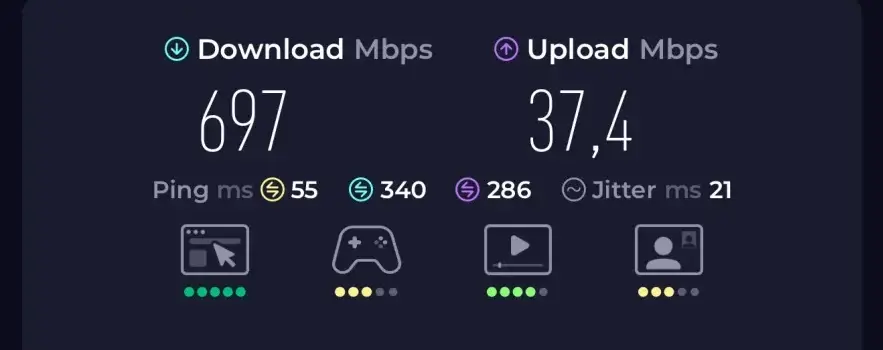
Performance. In Norway, Nomad absolutely stole the show. I measured a staggering download speed of nearly 700 Mbps: to put that into perspective, that's almost ten times faster than Holafly. Stability was flawless throughout my trip.
The plan. I tested a European regional plan rather than a specific Norwegian local plan. Interestingly, at the time of writing, this European option offers better value than the local plans, especially if you want a large data bundle. The European plan covers 30+ countries, which brings two big advantages.
Nomad: Pros
- Record-breaking download speeds (nearly 700 Mbps on 5G)
- European plan works in the UK, so you can install, activate and test it before you fly
- Same eSIM works across the border in Sweden and Denmark
- Great value, especially on larger bundles
Nomad: Cons
- I tested the European regional plan, which may differ from a Norway-only local plan
Featured Nomad plans for Norway
-
 Nomad Local Norway - 30 Days - 5 GBNorway only5GData5 GBValidity30 days£9.24£7.85£1.57/GB£9.24£1.85/GB−15% with code
 - Nomad Local Norway - 30 Days - 20 GBNorway only5GData20 GBValidity30 days£14.79£12.57£0.63/GB£14.79£0.74/GB−15% with code
Ubigi: Most reliable
Ubigi is consistently one of my top recommendations. As a subsidiary of the telecom giant Transatel, it has direct agreements with local networks. This sets it apart from many other providers who essentially just resell roaming data. Use code FYESIM10 for 10% off your plan.
Performance. The speed in Norway was excellent. I clocked 568 Mbps download and 31.4 Mbps upload. The connection was incredibly stable, making it one of the better providers I tested, perfect for high-quality video streaming or calls.
Local presence. A unique feature of Ubigi is that it assigns a local IP address to your eSIM. When you're in Norway, you browse the web just like a local, which is incredibly practical if you need to access local websites or services that might otherwise be geo-blocked. Ubigi is also rolling out a feature that lets you switch between a local IP and an IP from your home country (currently available for users from a handful of countries, with more to follow).
Ubigi: Pros
- Direct agreements with local networks (not just reselling roaming data)
- Local Norwegian IP address, so you browse like a local
- Excellent, very stable 5G speeds (568 Mbps in my test)
Ubigi: Cons
- Not the cheapest provider, so if you only want to message and browse you can find cheaper options
Featured Ubigi plans for Norway
-
 Ubigi NORWAYNorway only5GData10 GBValidity7 days£8.00£7.20£0.72/GB£8.00£0.80/GB−10% with code
 - Ubigi NORWAYNorway only5GData25 GBValidity30 days£18.00£16.20£0.65/GB£18.00£0.72/GB−10% with code
All Test Results
In Norway I found that, generally, all plans performed well, though there were significant outliers at both ends of the spectrum. Jetpac, Ubigi and Nomad were particularly strong on both download speeds and stability. Holafly, on the other hand, was by far the slowest: despite advertising 5G access, it never connected to 5G, not even in the heart of Oslo.
I tried all the plans across Oslo and Asker. The speed tests below were conducted in Asker (a town roughly 20 kilometres outside of Oslo) on an iPhone 16 Pro with the Ookla app. To ensure a fair comparison, all tests were completed within 30 minutes of each other at the exact same location.
| Provider | Speeds (Mbps) | Stability | Routing |
|---|---|---|---|
| Jetpac | 616 ↓ / 54.3 ↑ | Very fast and responsive. Great for downloads, streaming and even casual gaming. | France (Telna) |
| Ubigi | 568 ↓ / 31.4 ↑ | Fast and stable. Works well for most use, including video calls and remote work. | France, with local Norwegian IP assigned |
| Airalo | 309 ↓ / 46.3 ↑ | Very fast and responsive. Great for downloads, streaming and even casual gaming. | France (Telna) |
| Holafly | 74.9 ↓ / 56.1 ↑ | Suitable for basic tasks like messaging or casual browsing. Less ideal for heavy video or remote work. The only eSIM without 5G. | France (Orange) |
| Nomad | 697 ↓ / 37.4 ↑ | Very fast. Suitable for most usage including streaming and casual gaming. | Belgium (BICS) |
| GoMoWorld | 418 ↓ / 24.0 ↑ | Fast and generally stable. Good for browsing and video calls; latency slightly higher. | Ireland (eir) |
| Saily | 153 ↓ / 30.0 ↑ | Good speeds, but high jitter can affect real-time calls and gaming. Browsing and streaming are fine. | UK (1Global) |
| Revolut | 149 ↓ / 27.3 ↑ | Good speeds, but high jitter can affect real-time calls and gaming. Browsing and streaming are fine. | UK (1Global) |
| Maya Mobile | 212 ↓ / 43.3 ↑ | Good speeds, but somewhat high jitter. Not ideal for live calls or gaming; fine for basic browsing. | France (Telna) |
| Voye Global | 493 ↓ / 24.2 ↑ | Decent speeds, but somewhat higher latency and jitter. Best for basic browsing, downloads and basic streaming. | Netherlands (Webbing) |
All providers were personally tested by me in Norway with an iPhone 16 Pro using the Ookla app. The speed tests were conducted in Asker (a town roughly 20 kilometres outside of Oslo), with all tests completed within 30 minutes of each other at the exact same location. Routing (which country the data passes through) is listed too, but providers can change this at any time.
Local networks in Norway
These are the major mobile networks in Norway:
- Telenor
- Telia
- ICE
The Norwegian mobile landscape is dominated by two major players. Telenor offers the most extensive overall coverage, particularly in remote areas. Telia is a strong competitor, often noted for its excellent 5G availability and performance in urban areas.
While 5G is widely available in tourist hubs like Oslo, Bergen and Tromsø, a stable 4G/LTE signal remains the standard in the rest of the country.
Advice for road trips. Your network experience matters if you plan to travel outside the cities. If you're planning a road trip to the fjords or travelling north to the Arctic Circle, I'd avoid the budget network ICE. While adequate for urban areas, it lacks the robust native coverage of Telenor and Telia in rural regions. Leaving populated areas, check the local coverage on a site like nPerf.
Most premium travel eSIMs (including Jetpac and Nomad) partner with Telia, ensuring access to a high-quality network throughout the country.
Buying a local SIM card

An eSIM is generally easier than a local SIM card. However, if you absolutely need a local Norwegian phone number (+47), or if your phone doesn't support eSIM, a local provider is your only solution. Unfortunately, it's a cumbersome process. Especially for average data amounts (10 to 20 GB), it's often far too expensive.
At Oslo Airport (Gardermoen) you'll find a WH Smith shop immediately upon entering the arrivals hall after baggage reclaim. Inside, there's a Sim Local counter selling Norwegian Lyca Mobile prepaid cards.
Prices at Oslo airport (2025):
- 30 GB: NOK 399 (around £28)
- 100 GB: NOK 499 (around £35)
(Prices fluctuate; always check the latest deals at the counter.)
A few tips:
- Passport mandatory. You strictly need your physical passport for the mandatory ID registration.
- Go to official stores. If you'd rather not use Lyca Mobile, I recommend visiting a dedicated Telenor or Telia store in the city. Avoid convenience stores (like Narvesen or 7-Eleven) for buying SIMs, as staff often can't help with the registration process.
- Top-up challenge. Make sure you buy enough credit upfront. Online top-ups for Norwegian carriers often require a Norwegian bank card, making it difficult for tourists to add data later, although vouchers are available at convenience stores.
Final thoughts
A major concern for many UK travellers visiting Norway is the potential cost of roaming. While some networks (like O2) still include Norway in their free zone, others like EE and Three charge daily fees that can add up quickly. For those travellers, a travel eSIM is the perfect way to avoid bill shock.
The Norwegian mobile infrastructure is truly world-class, and the best eSIMs take full advantage of it. My tests showed massive performance differences, with the top providers hitting speeds of nearly 700 Mbps (5G) while others failed to connect to 5G entirely.
In short, these are my top picks for mobile data in Norway, based on my tests:
- Jetpac (best overall, plus free lounge access when your flight is delayed)
- Nomad (best speeds, nearly 700 Mbps on the European plan)
- Ubigi (best for reliability and a local IP)
Or compare 50+ providers yourself. Sort it out before you fly and you're online the moment you land.

Founder of Find Your eSIM. An avid traveller with roots in telecom, he works fully remote and has been hands-on testing travel eSIMs since 2023. He only recommends providers he'd use himself.